
Inscriete la noutatile noastre

Livrăm gratuit în raza municipiului Chișinău comenzile ce depășesc valoarea de 500 lei.
02 Aug 2020
MILK VALUE CHAIN ANALYSIS: THE CASE OF THE REPUBLIC OF MOLDOVA
Artur GOLBAN, Rita GOLBAN
State Agrarian University of Moldova
Rezumat.
Competitivitatea unui produs poate fi evaluată utilizînd analiza lanţului valoric care reprezintă totalitatea
activităţilor necesare pentru a aduce un produs de la faza sa conceptuală la faza finală de folosire. Lanţul
valoric include designul, producţia, marketingul, distribuţia şi suportul de a duce produsul spre consumatorul final.
Producţia de lapte reprezintă un sector important al economiei naţionale, fiind produs în mare parte în gospodăriile
populaţiei (95% din volumul total de lapte) şi aproximativ cinci procente din volumul total de lapte este produs în
întreprinderile agricole. Articolul are obiectivul de a prezenta o analiză a lanţului valoric al laptelui, principalele
probleme cu care se confruntă producătorii de lapte la nivelul lanţului valoric, de a propune soluţii în vederea sporirii
competitivităţii laptelui. Pentru studiu s-au utilizat date statistice colectate de la Biroul Naţional de Statistică al
Republicii Moldova şi baze de date internaţionale. Rezultatele investigaţiilor oferă posibilitatea de a înţelege rolul
fiecărui element al lanţului valoric al laptelui în sporirea competitivităţii acestuia.
Cuvinte cheie: Producţie de lapte; Lanţ valoric; Competitivitate, Întreprinderi agricole.
Abstract.
The competitiveness of a product can be evaluated using the value chain analysis which represents the
needed steps of the development cycle or process through which a product proceeds from its initial concept to production
and final sale. The value chain includes the design, production, marketing, distribution and support to bring
the product to its final consumer. Milk production sector is of great importance to the national economy. However,
the milk is produced mostly in private households (95% from total volume of milk) and approximately five percent is
produced in agricultural enterprises. The paper has the purpose to present the value chain analysis of milk, the major
problems the milk producers face at the value chain level and to propose solutions in order to increase the competitiveness
of milk production. For this study, data provided by the National Bureau of Statistics of the Republic of Moldova
and international commercial databases, were used. The results of the research give the possibility to understand
the role of each element of the milk value chain in increasing the competitiveness of this product.
Key words: Milk production; Value chain; Competitiveness; Agricultural enterprises.
INTRODUCTION
Milk represents an important animal origin product, because it contains all substances needed for
the normal growth and development of the organism. For example, the newborns calves live and develop
normally consuming only milk long after they are born. One liter of cow milk contains 640-680
calories, which represents a high caloric value of this product compared to other food products, which
being calculated in calories, is equal to 0.600 kg of beef; 0.750 kg of veal; 0.400 kg of pork; 8-9 eggs;
0.500 kg of fish (Golban, R. 2015). Analyzing the scientific literature, it was revealed that milk is also
called the „white blood” or the „spring of health”, due to its important substances need for the biological
development of the organism.
Milk production in the Republic of Moldova has a crucial importance for the economic growth of the
country. In order to understand the creation of the added value in the process of milk production, it is
very important to use both qualitative and quantitative approaches in analyzing the value chain.
The value chain analysis was introduced by Michael Porter as an instrument of identifying the sources
of competitive advantage in order to analyze the competitiveness of a product. The value chain method
represents a graphic presentation of its constituent elements: from raw materials to final products
(Porter, M. 1998; Golban, A. 2013; Belostecinic, G. 1999).
The basic objective of this scientific research is to analyze the elements of the milk value chain, the
problems the milk producers face at different levels of the value chain and to propose solutions in order
to improve the relations between the actors of the milk value chain.
MATERIALS AND METHODS
The scientific research is based on the data provided by the National Bureau of Statistics of the Republic
of Moldova and international commercial databases. In order to perform this investigation, the
following research methods were used: comparative analysis, logical analysis, analysis and synthesis,
induction, deduction, graphic method. The research is based on scientific and theoretical information on
competitiveness taken from the economic literature.
RESULTS AND DISCUSSIONS
The agricultural sector plays a strategic role in the process of economic development of the Republic
of Moldova. The share of agriculture, forestry and fishery in GDP during 2011-2016 reveals that this
sector contributes to GDP by 10-12 % (figure 1).
In 2016 the share of agriculture, forestry and fishery in GDP constituted 12,2 %, which represents an
increase compared to 2015 by 0.5% (BNS, 2016).
.png)
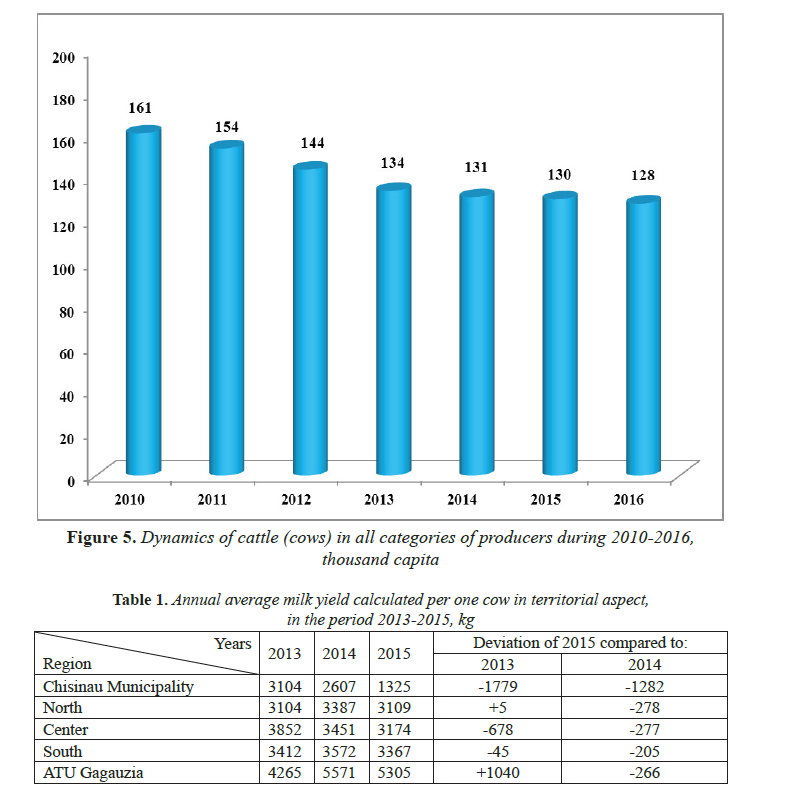
Analyzing the annual average milk yield calculated per one cow, we can say that in 2015 this indicator
recorded negative values compared to 2014 (table 1). The highest value of the annual average
milk yield calculated per one cow was rerecorded in ATU Gagauzia – 5305 kg, being followed by the
Central Region – 3174 kg (the highest productivity per cow was registered in Calarasi – 5380 kg of
milk, Ialoveni – 4009 kg of milk, Telenesti – 3682 kg of milk) and the North Region occupied the third
place - 3109 kg (Ocnita – 6495 kg of milk per cow, Singerei – 5454 kg of milk per cow, Falesti – 6668
kg of milk per cow).

The data presented in figure 6 indicate that the level of milk and dairy products consumption
in the Republic of Moldova is low, being equal to 170 kg per capita per year. The countries that
consume the most milk and dairy products are the following: Netherlands – 350 kg per capita
per year being followed by Poland – 280 kg per capita per year, Denmark – 260 kg per capita
per year (BNS, 2013).
Due to the fact that the level of milk and dairy products consumption in Republic of Moldova
is low, this creates a market potential that could be exploited by competitive domestic or
foreign companies.
According to a study performed by Magenta Consulting regarding the consumption of milk and
dairy products (641 persons participated in the study), approximately ¾ of Moldovans consume
milk. The persons who excluded milk consumption from their diets are the Moldovans who have
a monthly income less than 1000 MDL or those who live in cities (Magenta Consulting, 2015).
The data presented in figure 6 indicate that the level of milk and dairy products consumption
in the Republic of Moldova is low, being equal to 170 kg per capita per year. The countries that
consume the most milk and dairy products are the following: Netherlands – 350 kg per capita
per year being followed by Poland – 280 kg per capita per year, Denmark – 260 kg per capita
per year (BNS, 2013).
Due to the fact that the level of milk and dairy products consumption in Republic of Moldova
is low, this creates a market potential that could be exploited by competitive domestic or
foreign companies.
According to a study performed by Magenta Consulting regarding the consumption of milk and
dairy products (641 persons participated in the study), approximately ¾ of Moldovans consume
milk. The persons who excluded milk consumption from their diets are the Moldovans who have
a monthly income less than 1000 MDL or those who live in cities (Magenta Consulting, 2015).
.png)
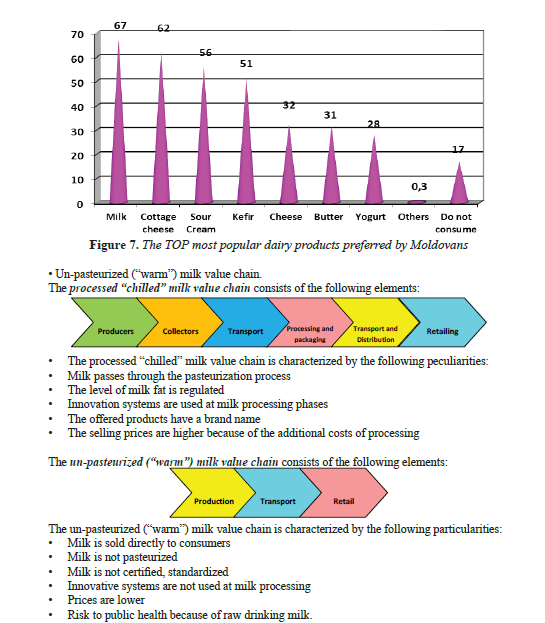
According to the performed questionnaire, the most-consumed dairy products by Moldovans
are milk, cottage cheese, sour cream and kefir. Approximately one third of the votes of those
who consume milk and dairy products were given to cheese, butter and yogurt.
Thus, all the dairy products mentioned above pass the path from the producer to the consumer
through the value chain, the needed steps of the development cycle or process through which a product
proceeds from its initial concept to production and final sale or from the producer to the final consumer.
The basic purpose of the value chain analysis is to understand the relations between the actors of the
value chain, their economic and social advantages (Porter, M. 2008).
Milk and dairy products are hugely important in the economy of the Republic of Moldova economy.
The competitiveness of milk and milk products can be evaluated using the value chain model.
The main competitors of milk and dairy products on Moldova’s local market in 2016 were the following:
• Ukraine, the exports of which constituted 50.4% (2.7 mln USD) out of total imports of milk,
• Georgia, the exports of which constituted 26.3% out of total imports of milk (1.4 mln USD),
• Libya, the exports of which constituted 8% out of total imports of milk (0.4 mln USD) (BNS,
2016).
In May, 2016, Moldova’s Government introduced restrictions to a large number of products originated
from Ukraine, among which dairy products. Local legislation established a limit that was taxed at
10-20% for the surplus of imported dairy products from Ukraine. The decision was made on the initiative
of local producers in order to protect the local market, being valid till the end of 2016.
The value chain of milk produced in the Republic of Moldova can be divided into two types:
• Processed (“chilled”) milk value chain;
Based on the above analyzed milk value chains we can conclude that the un-pasteurized (“warm”)
milk value chain is risky for the human health and should be controlled and regulated at the state level.
At the same time, adequate conditions should be created in order to ensure that the biggest milk processing
enterprises produce high quality milk. The activity of milk collectors is not well organized (Ignat,
A. 2013). The collectors should be equipped with cooling technologies. They should be well trained in
order to improve the quality of performed services.
Another big problem is that only a few milk processing companies have ISO certification, which
represents a barrier in the export of milk to foreign markets (Golban A., Golban R. 2017).
In the context of the above mentioned problems, there should be taken measures in order to improve
the milk value chain especially by increasing the quality of milk and dairy products and also by improving
the legislative framework such that local milk and dairy food producers enjoy direct access to
foreign markets.
CONCLUSIONS
The performed investigations on milk value chain gave us the possibility to formulate the following
conclusions:
Milk production in the Republic of Moldova is extremely important to the economic growth of the
country. The share of milk production of the total agricultural production during 2013-2015, recorded
an increase from 8% to 10.7%;
Private milk-producing households recorded the highest amount of milk production – 95%, while the
agricultural enterprises produce only 5%.
The level of milk and dairy products consumption in the Republic of Moldova is low, being equal to
170 kg per capita per year, while in Netherlands – 350 kg per capita per year, being followed by Poland
– 280 kg per capita per year and Denmark – 260 kg per capita per year;
Based on the performed analysis, the most popular dairy products preferred by Moldovans are milk,
cottage cheese, sour cream and kefir.
The un-pasteurized (“warm”) milk value chain is risky for the human health because the pasteurization
process is not controlled and not regulated at the state level;
The activity of milk collectors is not well organized; therefore it is necessary to take measures in
order to ensure them with cooling technologies and to organize different trainings for improving the
quality of performed services.
Only a few milk processing companies have ISO certification, which represents a barrier in the export
of milk and dairy products.
In order to increase the competitiveness of milk and dairy products, it is necessary to improve the legislative
framework in order to increase the access of local milk and dairy producers on foreign markets.
REFERENCES
1. BNS. Anuarele statistice ale Republicii Moldova pe anii 2011-2016.
2. BELOSTECINIC, G. (1999). Concurenţă, marketing, competitivitate. Chişinău. 140 p. ISBN 9975-75-
053-2.
3. GOLBAN, A. (2013). Evaluarea metodelor de determinare a competitivităţii unităţilor agricole. In: Lucrări
ştiinţifice, UASM. Vol. 37, pp. 244-247. ISBN 978-9975-64-252-1.
4. GOLBAN, A., GOLBAN R. (2017). Evolution of milk production in Republic of Moldova and the role of
quality management in increasing the competitiveness of milk processing companies. In: Scientific papers,
UASVM Bucharest. Series Management, Economic Engineering in Agriculture and Rural Development.
2017, vol. 17(2), pp. 129-135. ISSN 2284-7995.
5. GOLBAN, R. (2015). The study of the coliform bacteria isolation from milk. In: Agricultura Moldovei, nr.
3-4, pp. 32-35. ISSN 0582-5229.
6. GOLBAN, R. (2015). Food microbiology. Course of lectures. Chisinau: UASM. 142 p.
7. IGNAT, A. (2013). Managementul producţiei de lactate din perspectiva cerinţelor Uniunii Europene: autoref.
tz. doct. în economie. Spec. 08.00.05 - Economie şi management (în activitatea de antreprenoriat). Chisinau.
35 p.
8. MAGENTA CONSULTING. Moldovenii sunt ¾ de lapte. Disponibil: http://consulting.md/rom/ statistici-sipublicatii/
moldovenii- sunt-de-lapte
9. PORTER, M. (1998). The competitive advantage of nations. 2nd ed. 896 p. ISBN 978-0-684-84147-2.
10. PORTER, M. (2008). Despre concurenţă. Trad. din lb. en. Dan Criste. Bucureşti: Meteor Press.
432 p. ISBN 978-973-728-278-1.
Data prezentării articolului: 15.09.2017
Data aceptării articolului: 17.10.2017
Apr
05
Наиболее распространенными формами воспаления молочной железы у коров являются острые серозное и гнойно-катаральное. Заболевание коров маститами сопровождаются большим материальным ущербом, который складывается из потерь от снижения молочной продуктивности, увеличения заболеваемости молодняка, преждевременной выбраковки высокопродуктивных животных из-за атрофии четвертей вымени, а также денежных затрат на лечение и профилактику [2, 6].
Oct
11
Систематический генетический мониторинг в популяциях позволяет контролировать уровеньгенетического разнообразия, использовать возможности маркерной селекции, включая оценку внутрипо-родной дифференциации, формирование оптимальной генеалогической структуры и селекцию на гетеро- зис. В статье приводится информация о генетической структуре популяций белорусских черно-пестрых коров в локусах лактопротеинов CSN3, LALBA, BLG. В двух хозяйствах, в локусах LALBA, BLG наиболее часто встречаемым – от 42% до 51% является гетерозиготный генотип АВ. В локусе CSN3 преимуществом обладали гомозиготы АА (65 % – 72 %).Аллели имели
Sep
02
В статье представлен новый минеральный концентрат, изготовленный специальным способом из костной ткани сельскохозяйственных животных. Минеральный концентрат представляет собой концентрированный источник кальция и фосфора и является альтернативой трикальцийфосфату. Для изучения химического состава и степени варьирования показателей содержания кальция и фосфора, были проведены испытания образцов отобранных от семнадцати опытных партий минерального концентрата. Лабораторные исследования показали, что более 70% из проанализированных образцов содержали кальций в диапазоне 380-420 г/кг и фосфор – в диапазоне 120-163 г/кг. Установлено, что в минеральном концентрате
Dec
16
Эффективное сохранение зернофуража повышенной влажности является важной проблемой кормопроизводства, особенно в Карпатском регионе Украины, климатические условия которого отличаются чрезмерной увлажненностью. Существующие способы хранения влажного зерна экономически не оправданы из-за высокой стоимости энергоносителей. Задачей исследований было усовершенствование процессов консервирования зернофуража повышенной влажности
Inscriete la noutatile noastre