.jpg)
.jpg)


Inscriete la noutatile noastre

Livrăm gratuit în raza municipiului Chișinău comenzile ce depășesc valoarea de 500 lei.
31 Jul 2020
CZU 619:614.31:637.4
CONDITIONALLY PATHOGENIC MICROFLORA OF THE CONSUMPTION EGGS AS A RISK OF TOXIC INFECTIONS
Olga JUNCU
State Agrarian University of Moldova
Abstract.
The investigations were aimed to establish the diversity of conditionally pathogenic microflora in a poultry farm producing eggs for consumption and to determine the critical points of eggs contamination with pathogenic microorganisms, which could be a risk of developing food toxic infections in humans. The samples of biological material for microbiological investigations were collected in the rooms where laying chickens are kept, from egg shells, from the equipment, in the room for egg collection, sorting, grading and packaging, from feed and manure. The inseminations were performed on ordinary, selective and specific nutrient media. As a result of bacteriological and bacterioscopic investigations the presence of Streptococcus colonies was detected on the Peptone Agar medium (room air and egg shell), fungus colonies on Saburo medium (room air and feed), Salmonella colonies on Bismuth Sulfite Agar and E. coli colonies on Endo medium (faeces). The level of eggs contamination with conditionally pathogenic or pathogenic microorganisms varies depending on the hygiene of the premises, equipment, primary and secondary packaging of eggs, air currents in the building and on the content of microorganisms in poultry faeces.Key words: Poultry; Eggs; Biological contamination; Microorganisms; Culture media.
INTRODUCTION
At present, the national production activity in the poultry sector has an increasing trend, which was favoured by increasing market demand, sufficiently satisfied offer of domestic producers and increasing demands on food quality. At the same time, there is an increased consumption of local food products on the detriment of imported products. On the national level, the rural development programs aim at establishing poultry farms with industrial type of production and with farming systems adapted to the EU requirements (Edgar, J., Held, S. et al. 2016; Lara, L.J, Rostagno, M.H. 2013) It is known that eggs represent a valuable food with a high content of biologically active ingredients used for human consumption or in industry for food production. Eggs are not laid in a sterile environment. In fact, eggs may be contaminated via two different ways: vertical transmission through the ovary (or transovarial transmission) or horizontal transmission through the shell (or trans-shell transmission). Through vertical transmission, bacteria are introduced from infected reproductive tissues into the eggs prior to shell formation. This form of transmission is mostly associated with pathogenic bacteria, namely Salmonella Horizontal transmission usually occurs from fecal contamination on the egg shells as the eggs are released via the cloaca, where the excretion of feces also takes place. It also includes the contamination through environmental vectors, such as farmers, pets and rodents (Ai-Harthi, M.A., El-Deek, A.A., Attia, Y.A. 2011; Bain, M.M., Nys, Y., Dunn, I.C. 2016; Hester, P.Y., Enneking, S.A. et al. 2013). From the point of view of natural biosafety, the eggs present on the surface a structure which has a special secreted mucus with germicidal effect. 1-2 weeks after the eggs were laid, the bactericidal effect is reduced. Under the secreted mucus the shell is porous, with pores sufficiently large to allow the passage of the microbial cells. Among the most common microorganisms of internal contamination is Salmonella species of the genus Salmonella enteritidis, Salmonella gallinarum, the genus Proteus mirabilis, Clostridium genus, the species of Clostridium perfringens, which may originate from external contamination. These microorganisms can produce endotoxins that lead to foodborne disease. While chicken eggs may be contaminated up to 1%, duck eggs may be contaminated in a proportion of up to 26% (Denagamage, T., Jayarao, B., et al. 2015; Janczak, A.M., Riber, A.B. 2015). Typically, the external contamination occurs after the expulsion of the egg, by means of air from the laying birds’ manure through direct contact with the environment and constitutes about 90% of egg microflora. The number of microorganisms on the egg shells is on average about 100,000 according to degree of cleanliness; with the prevalence of Gram-positive bacteria of the genul Micrococcus with a high resistance on the egg shells. If the egg is in contact with air moisture, the pores from the surface of the egg shell facilitate the penetration of bacteria through them. Similarly, the transmissible pathogenic (123-127) 124 Ştiinţa agricolă nr. 1 (2017) bacteria may contaminate the egg by manure with bacteria belonging to the genus Salmonella,Staphylococcus, Proteus, Escherichia.Monitoring the epidemiological situation of eggs production and performing the schedule of veterinary control of such microorganisms as Salmonella enterica, Salmonella pullorum, Salmonella gallinarum and Salmonella arizonae represent compulsory measures that should be carried out in chicken flocks (Edgar, J., Held, S. et al. 2016; Janczak, A.M., Riber, A.B. 2015). Simultaneously, the program stipulates the inspection of flocks during each period of laying, taking samples for laboratory investigations, and if appropriate, blood from one day old chicks and also cloacal and tracheal samples. It also excludes taking samples from the chickens that were treated with antibiotics or were vaccinated in case of serological monitoring. Epidemiological surveillance must be continued during the periods of young chicken growth, before the period of laying and then every three months. Taking into consideration the above mentioned facts, the purpose of proposed research was to determine the diversity of bacterial flora in the poultry premises for consumer egg production and to make the analysis of critical points of egg contamination by pathogenic or conditionally pathogenic microflora (Bain, M.M., Nys, Y., Dunn, I.C. 2016; Shang, H.M. et al. 2010).MATERIAL AND METHODS The researches were carried out at the poulty farm „Pasarea argintie” (Silver bird), Chisinau municipality, which produces eggs for consumption and in the Laboratory of Microbiology, Department Clinics II, Faculty of Veterinary Medicine and Animal Science, SAUM. As samples for the laboratory investigations have served lavages taken from various places of the poultry farm such as rooms for chicken maintenance, samples of room air, lavages from the shell of laid eggs, samples from the equipment in the room, lavages of manure, samples of fodder, lavages from the rooms of egg collection, sorting and packaging and egg packages. The biological material has been sent to the laboratory for bacteriological and bacterioscopic investigation using ordinary, selective and differential nutrient media (Peptone Agar, Endo, Bismuth Sulfite Agar, Saburo and Levin medium). As a result of this research, attention was paid to the following microbiological criteria
:- morphological structure of colonies that have grown on nutrient media;
- bacteriological microflora isolated on nutrient media;
- sensitivity of bacterial microflora to certain antibiotics
RESULTS AND DISCUSSIONS
The figures 1-4 present images regarding the method of taking sample lavages of biological material for microbiological investigations. Sterile Petri dishes with nutrient media were placed in the premises where the laying birds are maintained, being open for contact with the ambient air for 10 minutes (fig.1). Concomitantly, using sterile brushes, there were taken lavages from the shell of laid eggs that came into contact with the environment (fig. 2), from the supports of the egg collection room (fig. 3) and inside the egg sorting and grading room (fig. 4).
.png)
.png)
In laboratory conditions, there were made inseminations on nutrient media in spiral forms with biological material from the collected lavages. Then, the Petri dishes were placed for incubation in the thermostat at a temperature of + 37°C for 48 hours. The bacteriological results of performed investigations are shown in the figures 5-10. Figure 5 presents the Streptococcus colonies, which developed on Peptone Agar medium, where the Petri dishes were exposed to the contact with the air inside the room for chicken maintenance. The colonies of Streptococcus are placed dispersed all over the surface of Petri dishes, being of gray colour, round and spherical in shape and of various dimensions. Fungal colonies developed on Saburo medium (fig. 6) in contact with the room air; these were of white
colour, fluffy and overgrown on the surface of the substrate.

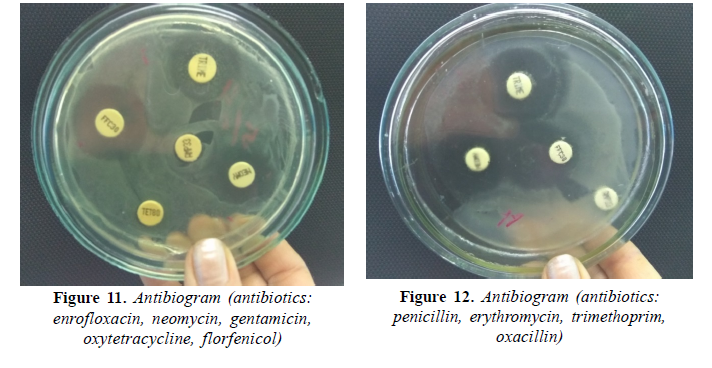
When inseminations were performed from the egg shells (fig. 7), the colonies of Streptococcus developed predominantly being of round and oval shapes. The feed samples on Saburo medium had demonstrated a massive presence of fungal flora, which developed all over the surface of Petri dishes, being of grayish colour and overgrown on the surface of the medium. In the case of inseminations performed from the manure lavages on the Bismuth Sulfite Agar (fig.9), after 48h of incubation, there were observed the development of Salmonella colonies of graybrown colour, placed in piles, oval in shape, while the colonies of E. coli developed on the Endo medium (fig. 10), being of various sizes ranging from gray to metallic gloss colour. After the isolation of microbial cultures from culture media was carried out, it was investigated their antibiotic resistance to certain broad spectrum antibiotics commonly used in veterinary medicine practices. In particular, there have been used disks soaked in such antibiotics as: erythromycin, enrofloxacin, florfenicol, trimethoprim, gentamicin, oxytetracycline, neomycin, oxacillin, penicillin.
.png)
Petri dishes were inseminated with microbial cultures isolated from the lavages taken within the poultry farm, then five disks soaked in various antibiotics were placed on each dish, which were placed in the thermostat at the temperature of 37°C for 48 hours. Subsequently, the retention of the microorganism colony growth was measured in mm. The results are shown on the antibiogram.
.png)
According to the investigation results of antibiotic resistance, presented in figures 11 and 12, the highest sensitivity of Streptococcus colonies was determined for the antibiotics trimethoprim and florfenicol, where the size of the inhibition zone was of 13 and 15 mm respectively. After that, the colonies of isolated microorganisms were stained according to Gram’s Method and examined under he biological microscope (Oc. 10x40) under immersion. The results of this study are presented in the
figures 13-14. Figure 13 presents the colonies of E. coli, which are of pink colour, have a bacillary form with oval heads and are placed in piles. Figure 14 shows the presence of Streptococcus, which are of blue colour, have a spherical shape and are placed in the form of chain, piles or ordinary.
CONCLUSIONS
1. Conditionally pathogenic microflora on the egg shells in the poultry premises and equipment for the maintenance of laying chickens predominantly consists of Streptococcus and E. coli.
2. The highest risk of egg contamination with pathogenic bacteria was detected in the room and equipment for egg collection and at the contact with the room air.
3. In order to prevent the contact of consumption eggs with pathogenic bacterial flora it is recommended to carry out a systematic microbiological monitoring of the critical points of microbiological contamination and systematically maintain rigorous sanitary conditions inside the premises, on the equipment and egg packages.
REFERENCES
1. AI-HARTHI, M.A., EL-DEEK, A.A., ATTIA, Y.A. (2011). Impacts of dried whole eggs on productive performance, quality of fresh and stored eggs, reproductive organs and lipid metabolism of laying hens. In: British Poultry Science, vol. 52(3), pp. 333-344.
2. BAIN, M.M., NYS, Y., DUNN, I.C. (2016). Increasing persistency in lay and stabilizing egg quality in longer laying cycles: what are the challenges? In: British Poultry Science, vol. 57(3), pp. 330-338. doi:10.1080/00071668.2016.1161727.
3. DENAGAMAGE, T., JAYARAO, B., PATTERSON, P., WALLNER-PENDLETON, E., KARIYAWASAM, S. (2015). Risk Factors Associated With Salmonella in Laying Hen Farms: Systematic Review of Observational Studies. In: Avian Diseases, vol. 59(2), pp. 291-302.
4. EDGAR, J., HELD, S., JONES, C., TROISI, C. (2016). Influences of Maternal Care on Chicken Welfare. In: Animals (Basel), vol. 6(1). doi: 10.3390/ani6010002.
5. HESTER, P.Y., ENNEKING, S.A., JEFFERSON-MOORE, K.Y., EINSTEIN, M.E., CHENG, H.W., RUBIN, D.A. (2013). The effect of perches in cages during pullet rearing and egg laying on hen performance, foot health, and plumage. In: Poultry Science, vol. 92(2), pp. 310-320.
6. JANCZAK, A.M., RIBER, A.B. (2015). Review of rearing-related factors affecting the welfare of laying hens. In: Poultry Science, 2015 vol. 94(7), pp. 1454-1469.
7. LARA, L.J, ROSTAGNO, M.H. (2013). Impact of Heat Stress on Poultry Production. In: Animals (Basel), vol. 3(2), pp. 356-369.
8. SHANG, H.M., HU, T.M., LU, Y.J., WU, H.X. (2010). Effects of inulin on performance, egg quality, gut microflora and serum and yolk cholesterol in laying hens. In: British Poultry Science, vol. 51(6), pp. 791-796.
Data prezentării articolului: 23.04.2017
Data acceptării articolului: 24.05.2017
Jul
26
Creșterea prepelițelor (Coturnix coturnix japonica) reprezintă un sector zootehnic în expansiune, caracterizat printr-un potențial productiv ridicat, dar vulnerabil la numeroși factori de risc care pot compromite performanțele economice. Studiul de față își propune investigarea managementului riscului în corelație cu apariția tehnopatiilor într-o fermă de prepelițe din județul Teleorman, în condiții de creștere intensivă. Cercetarea a urmărit elaborarea și aplicarea unui algoritm de diagnostic (care a inclus anamneza, examenul clinic și determinări paraclinice) pentru identificarea principalilor factori de risc implicați în apariția tulburărilor patologice. Rezultatele obținute evidențiază rolul determinant al nutriției, microclimatului și managementului tehnologic în declanșarea tehnopatiilor, manifestate prin scăderea producției de ouă, neuniformitatea loturilor, tulburări de creștere și sporirea mortalității. Concluziile studiului subliniază necesitatea implementării unor măsuri integrate de biosecuritate și management, precum și importanța utilizării unui algoritm diagnostic complex pentru prevenirea și controlul dezechilibrelor metabolice.
Jul
13
c Evaluarea a fost făcută pe probe de sânge din loturi de pui broiler ROSS 308, vaccinați contra pseudopestei aviare, bursitei, bronșitei aviare și rinotraheitei infecțioase aviare, pe probe recoltate la vârste prestabilite. Au fost determinate titrurile anticorpilor postvaccinali specifici acestor boli. Loturile imunizate cu vaccinuri vii și inactivate împotriva pseudopestei aviare, bursitei infecțioase, bronșitei infecțioase și rinotraheitei aviare au prezentat la vârsta de 36 de zile valori protective. Aceste rezultate confirmă efectul benefic al imunizării obligatorii și de necesitate a puilor de carne în controlul bolilor infecțioase la această categorie zootehnică.
Dec
04
Identificarea agenţilor patogeni este esenţială pentru menţinerea siguranţei alimentare, ajutând la descoperirea surselor de contaminare şi la protejarea sănătăţii publice. Sursele de contaminare în alimente sunt diverse şi pot apărea pe parcursul întregului lanţ alimentar, de la producţie la distribuţie. Rezistenţa la antibiotice observată la unii agenţi patogeni reprezintă un risc semnificativ pentru sănătatea publică, subliniind nevoia unor strategii stricte pentru gestionarea utilizării antibioticelor în producţia alimentară şi importanţa efectuării profilului de rezistenţă la antimicrobiene. Măsurile preventive bazate pe evaluarea diversităţii microbiologice şi pe identificarea riscurilor pot reduce contaminarea alimentelor şi îmbunătăţi siguranţa alimentară. Monitorizarea continuă şi adaptarea practicilor din industria alimentară la noile descoperiri microbiologice sunt esenţiale pentru a menţine un lanţ alimentar sigur şi a limita riscurile microbiologice. Respectarea normelor de igienă şi calitate trebuie îmbunătăţită constant pentru a asigura conformitatea produselor alimentare cu standardele de sănătate publică şi pentru a preveni riscurile de contaminare.
Jun
11
Gripa aviară, sau influenţa aviară, infecţie produsă de virusul influenza de tip A, afectează păsările domestice şi sălbatice, fiind răspândită în întreaga lume. Infecţia evoluează asimptomatic la diferite specii de păsări acvatice, acestea fiind purtătoare şi eliminatoare de virus, având un rol major în epidemiologia acestei infecţii. Păsările domestice dezvoltă infecţii clinic manifeste, a căror evoluţie este determinată de patogenitatea tulpinii. Infecţiile cu tulpini înalt patogene (HPAI) la puii de carne evoluează clinic sever, cu rate de mortalitate ridicate. Conduita preventivă are la bază biosecuritatea. Biosecuritatea reprezintă complexul de măsuri care se impun a fi aplicate la nivelul fermei de pui de carne, având drept obiectiv reducerea riscului de a introduce tulpini de virus gripal de tip A la nivelul fermei.
Inscriete la noutatile noastre